
Washington County Release Date Terms
Florida uses three date labels that should not be collapsed. Section 944.275 calls FDC’s gain-time calculation the tentative release date. An active Inmate Population detail can show a public-facing Current Release Date. The separate Inmate Release Information detail uses Release Date for a completed state event. A current or tentative date is an estimate. A completed release date records what FDC says occurred.
County jail records use a different path. Washington County Jail holds arrestees awaiting court, people serving local sentences, and people held for another authority. A pretrial person has no sentence-based date to calculate. Bond, a recognizance order, dismissal, a detainer, or a transfer can determine when county custody ends. Even after a judge signs an order, staff may need time to check holds and finish release processing.
| Field | Meaning | Authority |
|---|---|---|
| Current Release Date | FDC’s public estimate on an active inmate detail | FDC Inmate Population |
| Tentative release date | The statutory projection after gain-time granted or forfeited | Florida Statutes §944.275 |
| Release Date | A completed FDC release event | FDC Inmate Release Information |
| Physical release time | When WCSO custody actually ended | Washington County booking and release record |
Run a Washington Release Lookup
Start with custody, not the sentence length. The WCSO current roster can confirm that someone is still in the county jail when a matching card is present. No match is not proof of release. It may mean transfer to FDC, another county, federal custody, or immigration custody. A state prisoner should be searched through the FDC Corrections Offender Network.
- Identify the custodian. Check WCSO for present county custody and FDC Inmate Population for state custody.
- For an active FDC prisoner, search by the six-character DC number when known. Open the matching detail and transcribe the Current Release Date exactly.
- Read the “information current as of” marker, offense date, sentence history, and any detainer fields. Do not turn the estimate into a countdown.
- For a county sentence, inspect the judgment in the Washington County public court portal. Then request WCSO’s actual sentence calculation or release record.
- After the person leaves FDC, repeat the search in Inmate Release Information. After WCSO custody ends, obtain the booking and release sheet.
- When a date is disputed, contact the record authority with the booking number or DC number and the public result’s date marker.
The official FDC Inmate Population Search is the state entry point for an active prisoner’s date field.
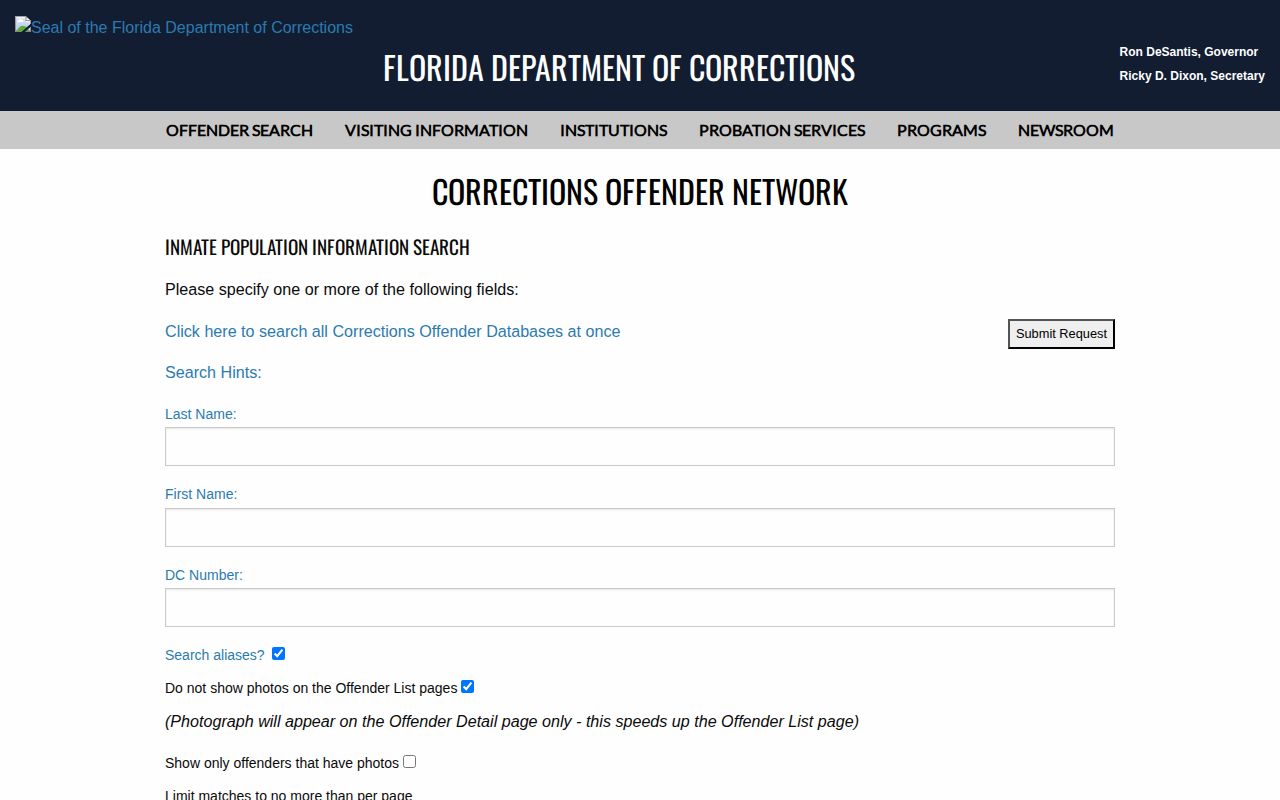
Its results apply to FDC custody, including Northwest Florida Reception Center, not to a county-only jail sentence.
Florida Washington Release Date Labels
Florida maintains a dedicated release database instead of forcing a released person into the active inmate locator. The Inmate Release Information Search is updated nightly and includes photographs and details for people already released or scheduled for release. Its name, scope, and separate search fields are important evidence that an active estimate and a past discharge are not interchangeable.
The search accepts last name, first name, six-character DC number, and an alias option. Photo controls can require or suppress images in results. A detail may show the committed name, aliases, photograph, DC number, Release Date, release type, sentence history, detainers, and Date Out-Custody. Check the entire history because an older completed release may not be the end of a later sentence.
The official stable FDC release example illustrates the completed labels.
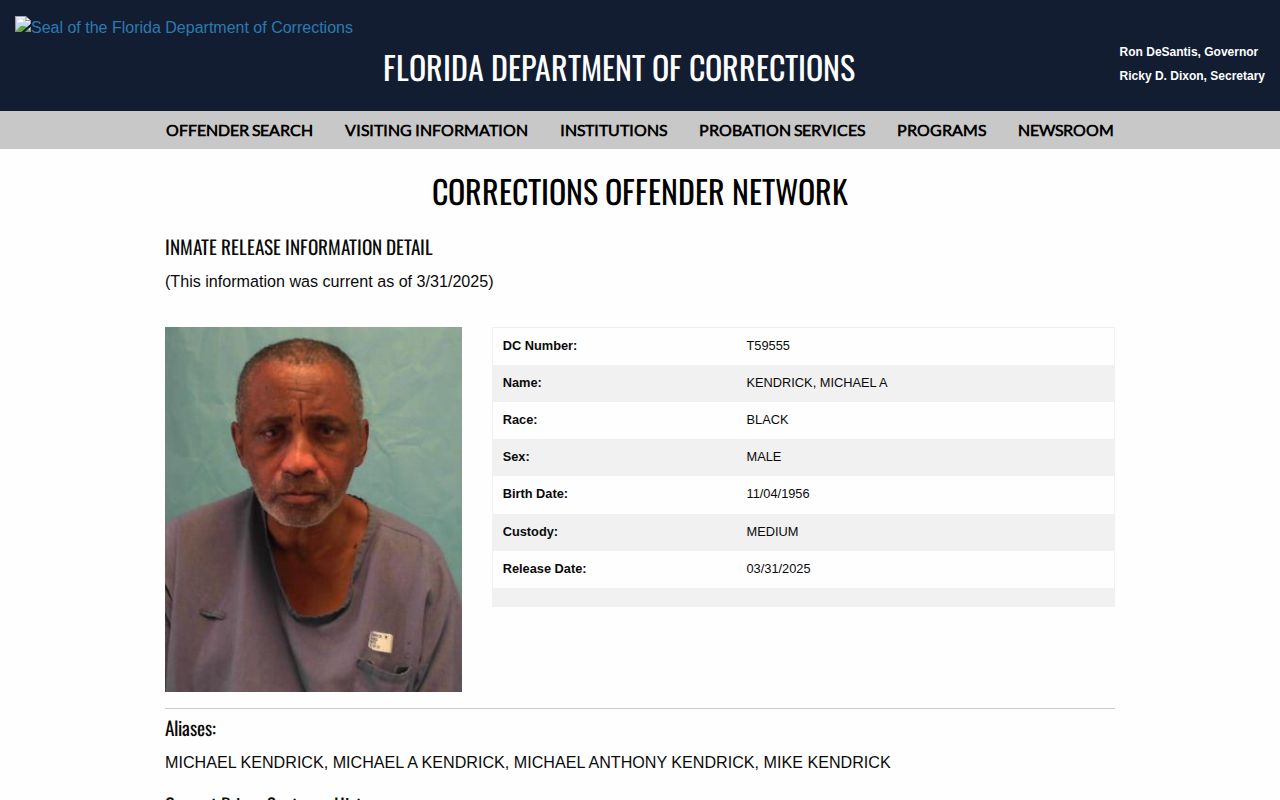
The image shows why the completed Release Date and Date Out-Custody fields should be used after discharge rather than carrying forward an old projection.
Washington Release Dates and Gain-Time
FDC begins with the sentence imposed by the court. It establishes a maximum sentence expiration date after lawful jail credit, then applies gain-time granted or forfeited to create the tentative release date. For a qualifying Criminal Punishment Code prison sentence, §§944.275 and 921.002 generally prevent gain-time from reducing service below 85 percent. The rule is a floor, not a promise that release will occur at exactly that point.
Offense date matters. Basic gain-time rules apply to older offense cohorts, while incentive and meritorious gain-time depend on the statute and corrections rules. Mandatory minimums, special sentence laws, and a life sentence can alter or remove the ordinary term-of-years calculation. Court-awarded time physically served can count toward the statutory floor, but the public should use the department’s computed field rather than subtract a flat percentage.
The Florida tentative-release-date and gain-time statute defines the calculation.
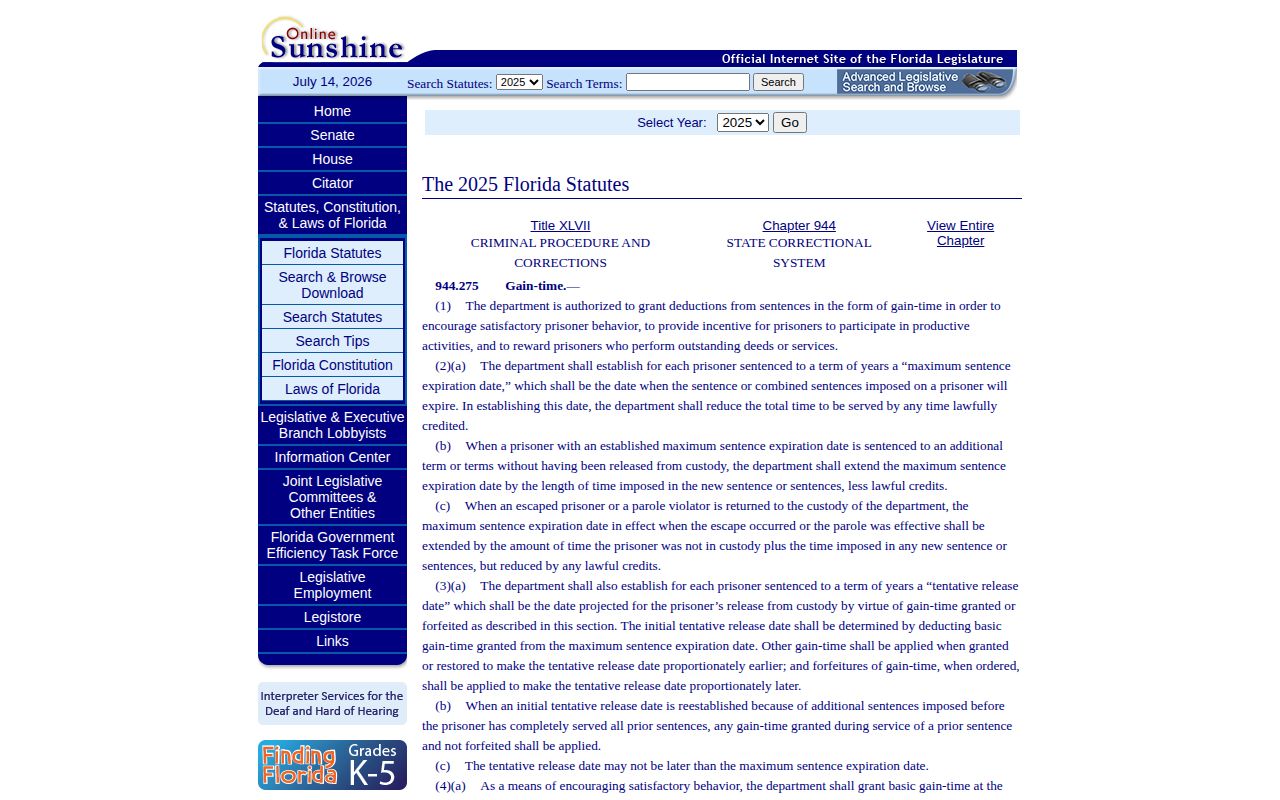
The statutory text is the source for the tentative date, while FDC’s live record is the source for the date computed in one person’s case.
Note: A ten-year example does not yield a reliable calendar date because credit, offense-date law, sentence structure, and gain-time changes remain person-specific.
Washington Release Calculation Records
A maximum sentence expiration date is not the same as the tentative release date. The maximum date begins with the imposed term or combined terms and lawful jail credit. FDC then applies gain-time rules to produce the tentative date for a prisoner serving a term of years. A mandatory term, concurrent or consecutive sentence structure, corrected commitment, or later sentence can change the calculation before any conduct credit is considered.
The best audit trail starts with the Washington County judgment and sentence. Record each case number, offense date, sentence date, term, and whether terms run together or one after another. Then compare those facts with the FDC detail. If jail credit differs, obtain the court’s certification under §921.161 and ask the clerk whether a corrected commitment was entered. FDC cannot replace an unclear court order with a guess, and a public user should not do so either.
Gain-time records add the next layer. Awards can advance the tentative date within the governing limit. Authorized forfeiture can move it later, and restoration can change it again. FDC’s public field gives the current result, not a full ledger of each calculation step. Questions about the computation go to the Bureau of Admission and Release. Classification and central-record questions go to 850-488-9859 or central.classification@fdc.myflorida.com.
A release plan or supervision term may affect what happens after the prison gate, but the supervision termination date should not be substituted for the custody release date. Conditional release can place a person in the community while a state obligation continues. Check the separate Supervised Population record after a completed prison release.
Washington County Jail Release Dates
County sentences are not calculated under FDC’s state-prison field. Florida §951.21 separately authorizes a county-prisoner good-conduct commutation schedule unless the county commission changes or discontinues it. The research found no current Washington County resolution or jail policy proving that the statutory maximum is used. It also found no published weekend or holiday early-release rule.
Do not apply the state 85-percent floor or the §951.21 maximum mechanically to someone at Washington County Jail. Use the clerk’s judgment and sentence, the court’s jail-credit certification under §921.161, and WCSO’s actual sentence calculation. A person awaiting trial has no fixed release date at all. The jail may hold the person until bond is posted, a judge acts, or another agency’s hold is resolved.
For a documentary answer, use the WCSO public-record request. Ask for the existing booking record, sentence calculation if releasable, release date and time, release type, and destination or receiving agency. The records custodian is Terisa Hayes, 711 Third Street, Chipley, FL 32428, 850-638-6070, records@wcso.us. The jail line, 850-638-6110, is suited to a present custody question.
A move from the Washington County Jail to Northwest Florida Reception Center can look local because both are in the county. Legally, it is a transfer from county to state custody. The FDC active record then controls the projected state date.
Why Washington Release Dates Change
A projected date can move in either direction. FDC recalculates after authorized changes, and a court correction can reach the department after an older public view was saved. A date also does not override a hold from another authority. Read the current record and its update marker each time accuracy matters.
| Factor | Possible effect | Where to verify |
|---|---|---|
| Gain-time awarded, lost, restored, or deleted | Moves the tentative date earlier or later within governing limits | FDC computation and §944.275 |
| Corrected commitment or new sentence | Changes term length, credit, or consecutive structure | Court judgment and FDC record |
| Mandatory minimum | Blocks an assumed gain-time reduction | Sentence and controlling statute |
| Detainer or receiving authority | May end one custodian’s period without community release | Release destination and receiving system |
| Escape or supervision violation | Can affect calculation or lead to renewed custody | FDC status and official action |
| Parole or conditional-release action | May set, delay, rescind, or condition a release event | FCOR order plus FDC release record |
Florida says population data receives a full weekly refresh, while release dates and location changes update nightly. A fast court or custody change can still arrive after a cached screen. FDC’s Bureau of Admission and Release answers state release questions at 850-488-9167 or dc.release@fdc.myflorida.com.
Confirm Washington County Release
Confirmation happens after the event. For FDC, use the Release Information detail and contact Admission and Release if the date needs an official explanation. For Washington County Jail, request the release sheet and compare it with the clerk docket. The court order can explain why release was authorized, while the sheriff record supplies the physical exit time.
Florida VINE can provide an alert for a release, transfer, escape, or other reported status change. Registration steps and source limits are covered in the VINE Inmate Check. VINE is not a certified release record, and a transfer alert does not mean the person entered the community.
Use the Washington County released-inmate search when the current custodian is unknown. It separates WCSO, FDC, federal, immigration, and court paths. That distinction prevents a projected state date from being assigned to a county detainee or a county roster disappearance from being treated as final release.
Record the search date, the exact field label, and the agency’s freshness marker. Near the expected date, check again because release and location changes can post after an earlier saved view. If another authority accepts custody, obtain the sending agency’s destination field and search the receiving system. The end of one custody record may be a transfer rather than freedom in the community.
A court event and a physical release can also fall on different dates. Preserve both. The docket shows legal authority, while the custodian records the act of release. When a precise timeline is needed, request each record instead of choosing the date that appears first online.